Tahi
October 8, 2015 12:15 am
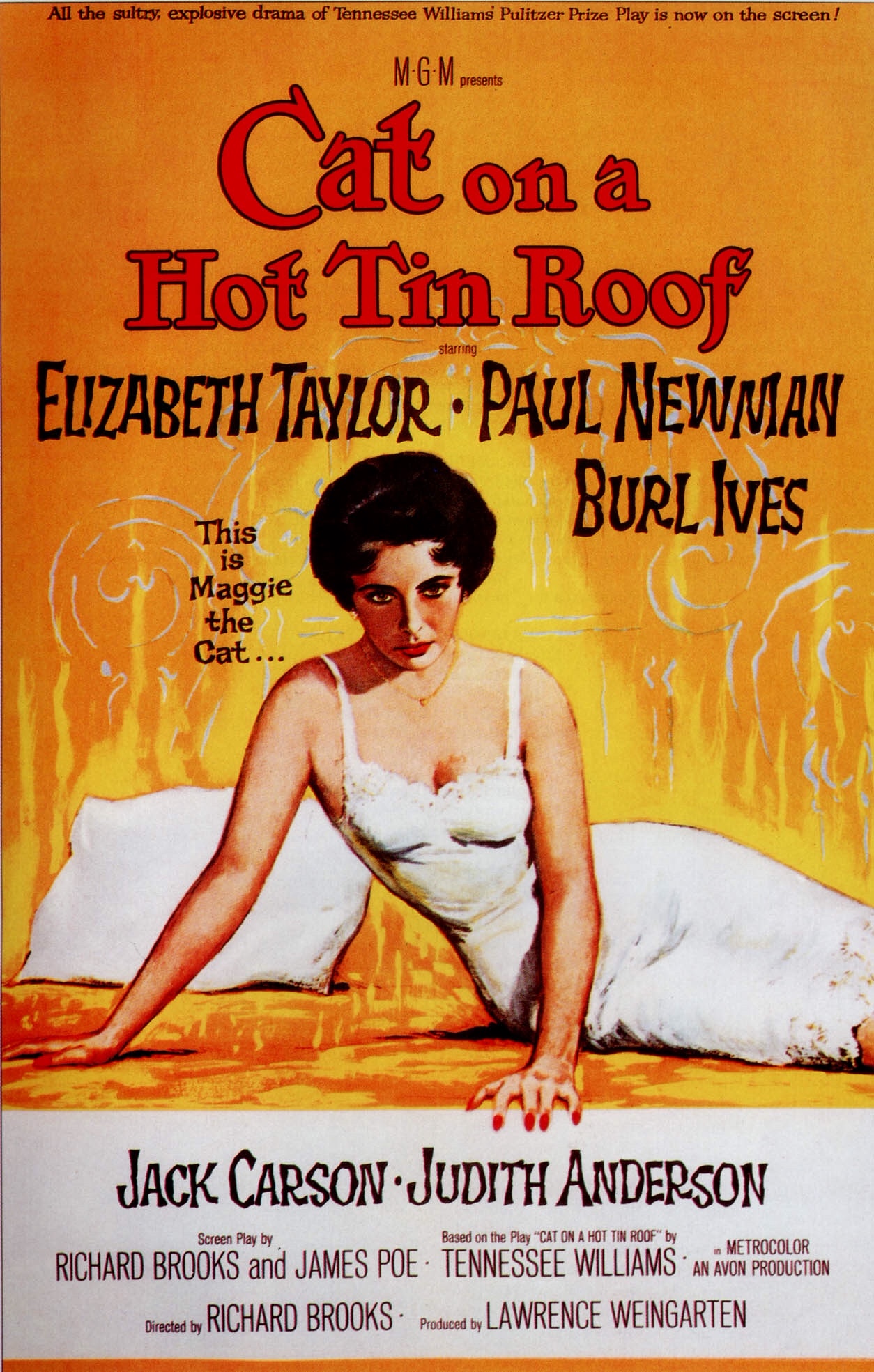
#### Notes on Cat On A Hot Tin Roof by Tennessee Williams
P15
- 'But Mae? Why did y'give dawgs' names to all your kiddies? MAE: Dogs' names? Margaret has made this observation as she goes to raise the bamboo blinds, since the sunset glare has diminished. In crossing she winks at Brick. MARGARET sweetly: Dixie, Trixie, Buster, Sonny, Polly!--Sounds like four dogs and a parrot--animal act in a circus! MAE: Maggie? Margaret turns with a smile. Why are you so catty? MARGARET: 'Cause I'm a cat! But why can't you take a joke, Sister Woman?'
- Hahahaha what a character. I'm still not entirely sure if she represents the bitter yet humorous half of a relationship that has long expired or the true power source in the relationship. Or both.
P11
- 'What is the victory of a cat on a hot tin roof?--I wish I knew.... Just staying on it, I guess, as long as she can.... More croquet sounds.'
- is that it?
- 'MARGARET: Laws of silence don't work.... When something is festering in your memory or your imagination, laws of silence don't work, it's just like shutting a door and locking it on a house on fire in hope of forgetting that the house is burning. But not facing a fire doesn't put it out. Silence about a thing just magnifies it. It grows and festers in silence, becomes malignant.... Get dressed, Brick.'
- A reminder for those in need of reminding.
P47
- 'BIG DADDY: A pig squeals. A man keeps a tight mouth about it, in spite of a man not having a pig's advantage.
BRICK: What advantage is that?
BIG DADDY: Ignorance--of mortality--is a comfort. A man don't have that comfort, he's the only living thing that conceives of death, that knows what it is. The others go without knowing, which is the way that anything living should go, go without knowing, without any knowledge of it, and yet a pig squeals, but a man sometimes, he can keep a tight mouth about it.'
- the luxury of uncompromising truth is perhaps a fallacy and folly told amongst foolish men to those they consider less wise than themselves.
P50
- 'BIG DADDY: All I ask of that woman is that she leave me alone. But she can't admit to herself that she makes me sick. That comes of having slept with her too many years. Should of quit much sooner but that old woman she never got enough of it--and I was good in bed... I never should of wasted so much of it on her.... They say you got just so many and each one is numbered. Well, I got a few left in me, a few, and I'm going to pick me a good one to spend 'em on! I'm going to pick me a choice one, I don't care how much she costs, I'll smother her in--minks! Ha ha! I'll strip her naked and smother her in minks and choke her with diamonds! Ha ha! I'll strip her naked and choke her with diamonds and smother her with minks and hump her from hell to breakfast. Ha ha ha ha ha!'
- The hysteria here is powerful. So much so I had to read it a few times just to relive it.
P66
- 'But Skipper, he had some fever which came back on him which doctors couldn't explain and I got that injury--turned out to be just a shadow on the X-ray plate--and a touch of bursitis.... I lay in a hospital bed, watched our games on TV, saw Maggie on the bench next to Skipper when he was hauled out of a game for stumbles, fumbles!--Burned me up the way she hung on his arm!--Y'know, I think that Maggie had always felt sort of left out because she and me never got any closer together than two people just get in bed, which is not much closer than two cats on a--fence humping.... So! She took this time to work on poor dumb Skipper. He was a less than average student at Ole Miss, you know that, don't you?!--Poured in his mind the dirty, false idea that what we were, him and me, was a frustrated case of that ole pair of sisters that lived in this room, Jack Straw and Peter Ochello!--He, poor Skipper, went to bed with Maggie to prove it wasn't true, and when it didn't work out, he thought it was true!--Skipper broke in two like a rotten stick-- nobody ever turned so fast to a lush--or died of it so quick.... --Now are you satisfied?'
P91
- 'NOTE OF EXPLANATION Some day when time permits I would like to write a piece about the influence, its dangers and its values, of a powerful and highly imaginative director upon the development of a play, before and during production. It does have dangers, but it has them only if the playwright is excessively malleable or submissive, or the director is excessively insistent on ideas or interpretations of his own. Elia Kazan and I have enjoyed the advantages and avoided the dangers of this highly explosive relationship because of the deepest mutual respect for each other's creative function: we have worked together three times with a phenomenal absence of friction between us and each occasion has increased the trust.'
P118
- 'Tennessee Williams was born in 1911 in Columbus, Mississippi, where his grandfather was the Episcopal clergyman. When his father, a travelling salesman, moved with his family to St Louis some years later, both he and his sister found it impossible to settle down to city life. He entered college during the Depression and left after a couple of years to take a clerical job in a shoe company. He stayed there for two years, spending the evenings writing. He entered the University of Iowa in 1938 and completed his course, at the same time holding a large number of part-time jobs of great diversity. He received a Rockefeller Fellowship in 1940 for his play Battle of Angels, and he won the Pulitzer Prize in 1948 and 1955. Among his many other plays Penguin have published The Glass Menagerie (1944), A Streetcar Named Desire (1947), Summer and Smoke (1948), The Rose Tattoo (1951), Camino Real (1953), Baby Doll (1957), Orpheus Descending (1957), Something Unspoken (1958), Suddenly Last Summer (1958), Sweet Bird of Youth (1959), Period of Adjustment (1960) and Small Craft Warnings (1972). Tennessee Williams died in 1983. Peter Shaffer has written of Tennessee Williams: 'He was a born dramatist as few are ever born. Whatever he put on paper, superb or superfluous, glorious or gaudy, could not fail to be electrifyingly actable. He could not write a dull scene.... Tennessee Williams will live as long as drama itself.'
- Oh the posthumous life is far better than the living one should turn out to be a writer or artist in any respect. Hurry up, die quickly, and be reborn and saint and superhuman in the eyes and hearts of the public.
P119
- 'Cat on a Hot Tin Roof 1st published in Great Britain by Martin Seeker & Warburg Ltd. 1956 Published in Penguin Books 1957 PERSON--TO--PERSON Of course it is a pity that so much of all creative work is so closely related to the personality of the one who does it. It is sad and embarrassing and unattractive that those emotions that stir him deeply enough to demand expression, and to charge their expression with some measure of light and power, are nearly all rooted, however changed in their surface, in the particular and sometimes peculiar concerns of the artist himself, that special world, the passions and images of it that each of us weaves about him from birth to death, a web of monstrous complexity, spun forth at a speed that is incalculable to a length beyond measure, from the spider mouth of his own singular perceptions. It is a lonely idea, a lonely condition, so terrifying to think of that we usually don't. And so we talk to each other, write and wire each other, call each other short and long distance across land and sea, clasp hands with each other at meeting and at parting, fight each other and even destroy each other because of this always somewhat thwarted effort to break through walls to each other. As a character in a play once said, 'We're all of us sentenced to solitary confinement inside our own skins.' Personal lyricism is the outcry of prisoner to prisoner from the cell in solitary where each is confined for the duration of his life. I once saw a group of little girls on a Mississippi sidewalk, all dolled up in their mothers' and sisters' cast-off finery, old raggedy ball gowns and plumed hats and high- heeled slippers, enacting a meeting of ladies in a parlour with a perfect mimicry of polite Southern gush and simper. But one child was not satisfied with the attention paid her enraptured performance by the others, they were too involved in their own performances to suit her, so she stretched out her skinny arms and threw back her skinny neck and shrieked to the deaf heavens and her equally oblivious playmates, 'Look at me, look at me, look at me!' And then her mother's high-heeled slippers threw her off balance and she fell to the sidewalk in a great howling tangle of soiled white satin and torn pink net, and still nobody looked at her. I wonder if she is not, now, a Southern writer. Of course it is not only Southern writers, of lyrical bent, who engage in such histrionics and shout, 'Look at me!' Perhaps it is a parable of all artists. And not always do we topple over and land in a tangle of trappings that don't fit us. However, it is well to be aware of that peril, and not to content yourself with a demand for attention, to know that out of your personal lyricism, your sidewalk histrionics, something has to be created that will not only attract observers but participants in the performance. I try very hard to do that.'
- ‘And still nobody looked at her’. Is that us? Even when we’re winning we’re never really being given the kind of regard we had hoped for.
P120
- 'But even now when that tongue-locking, face-flushing, silent and crouching timidity has worn off with the passage of the troublesome youth that it sprang from, I still find it somehow easier to 'level with' crowds of strangers in the hushed twilight of orchestra and balcony sections of theatres than with individuals across a table from me. Their being strangers somehow makes them more familiar and more approachable, easier to talk to. Of course I know that I have sometimes presumed too much upon corresponding sympathies and interest in those to whom I talk boldly, and this has led to rejections that were painful and costly enough to inspire more prudence. But when I weigh one thing against another, an easy liking against a hard respect, the balance always tips the same way, and whatever the risk of being turned a cold shoulder, I still don't want to talk to people only about the surface aspects of their lives, the sort of things that acquaintances laugh and chatter about on ordinary social occasions.'
- The funny thing is this sounds like the type of waffling that would tend to make no logical sense but in fact every line, every word is essential to the expression of something very true and real for the writer. I love the lines ‘… I have sometimes presumed too much upon corresponding sympathies and interest in those whom I talk boldly, and this has led to rejections that were painful and costly enough to inspire more prudence…’ and ‘the sort of things that acquaintances laugh and chatter about on ordinary social occasions.’ Finished well with a simplistic term, nicely done.
P130
-'BRICK to the moon: I envy you--you cool son of a bitch.'
P13
- 'BRICK: How long are you goin' to stand behind me, Maggie? MARGARET: Forever, if necessary.'
- Tennessee’s use of symbolism seems too apparent to be so heralded as it is. Maybe I’m missing something or perhaps the accommodating nature of his work is what has gained him such widespread recognition.