Delft Holland
October 3, 2015 3:10 pm
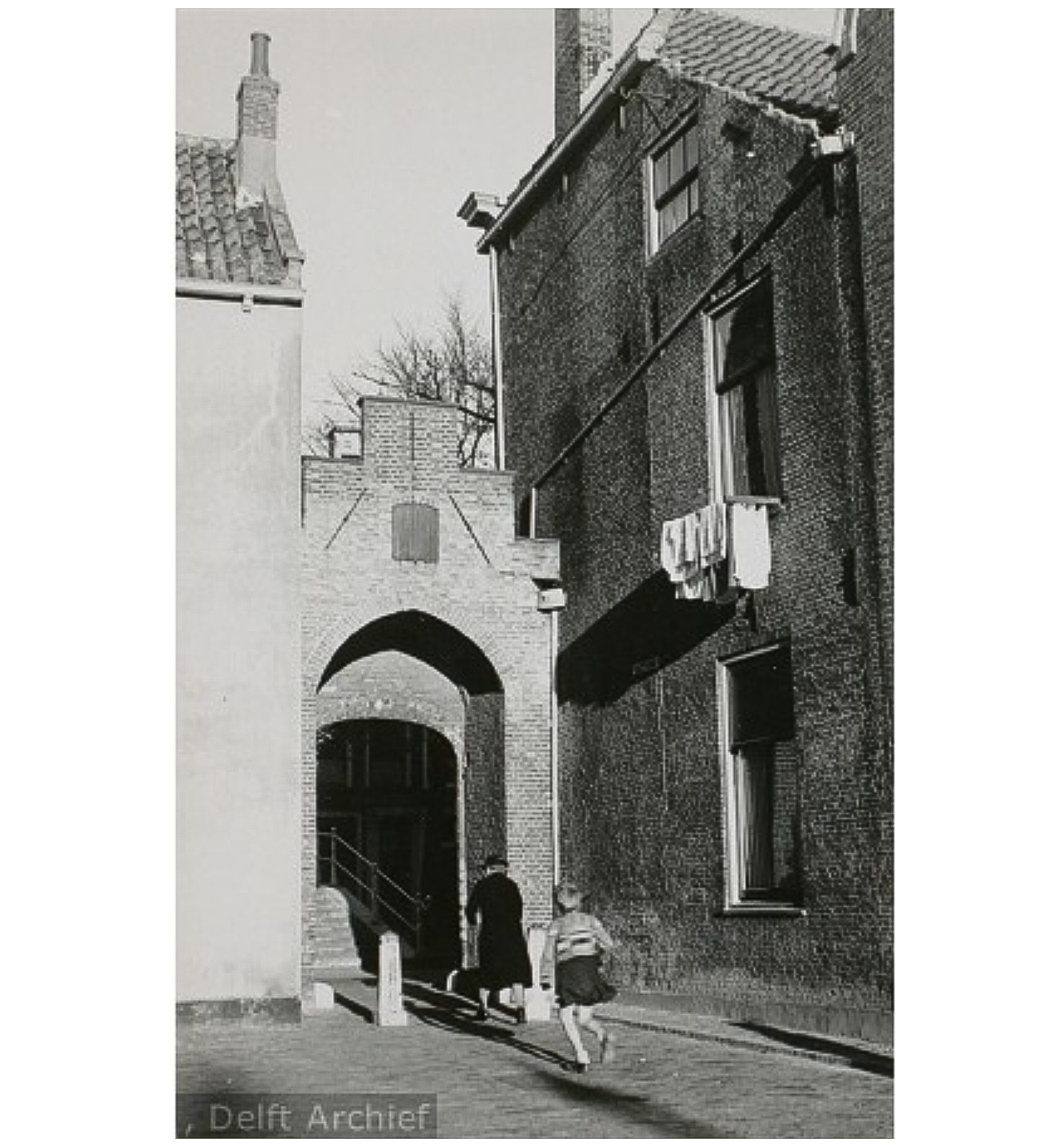
BAGIJNHOF DELFT 1955
A woman and a child walk from the Bagijnhof the Bagijn Hofpoort direction Oude Delft. A Bagijn (actually Beguine) is a widow or an unmarried woman without make a monastic vow, with others in separate cottages around a garden courtyard or living together as a spiritual sister. Such communities were created since the 13th century. Beguines lived there already in 1271 in Delft. The most famous inhabitant of the medieval Bagijnhof is Geertruyt East. On the Oude Delft Silk is the Bagijnhofpoortje that predates 1400. Contains a strongly weathered relief suggests that John on Patmos. The current relief is a copy. The original was so weathered that could be salvaged only a few small parts. A fragment of the original state since 1985 in the hall of the Reinier de Graaf Hospital (Building Bethel).
Een vrouw en een kind lopen vanaf het Bagijnhof naar de Bagijnhofpoort richting Oude Delft. Een bagijn (eigenlijk begijn) is een weduwe of een ongehuwde vrouw die, zonder een kloostergelofte af te leggen, met anderen in aparte huisjes rondom een tuin of hof samenleeft als een geestelijke zuster. Zulke gemeenschappen ontstonden sedert de 13e eeuw. Er woonden al in 1271 begijnen in Delft. De bekenste bewoonster van het middeleeuwse Bagijnhof is Geertruyt van Oosten. Aan de Oude Delftzijde bevindt zich het Bagijnhofpoortje, dat van vóór 1400 dateert. Hierin bevindt zich een sterk verweerd reliëf dat Johannes op Patmos voorstelt. Het huidige reliëf is een kopie. Het origineel was zozeer verweerd, dat slechts enkele kleine delen konden worden geborgen. Een fragment van het origineel staat sedert 1985 in de hal van het Reinier de Graafgasthuis (gebouw Bethel).
More Photos BAGIJNHOF 114:
https://commons.m.wikimedia.org/wiki/Category:Bagijnhof_114,_Delft